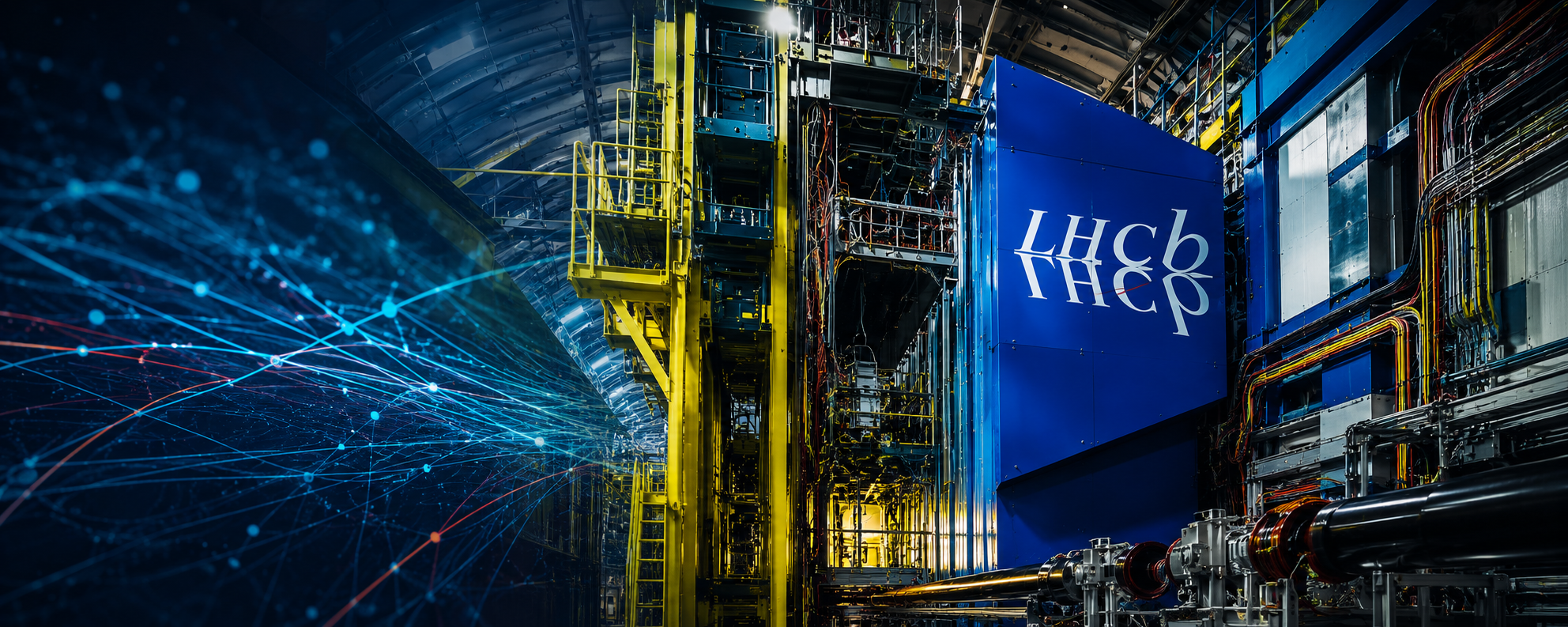
UKRI and STFC have cut funding for the next-generation upgrade of the LHCb experiment at the Large Hadron Collider (LHC) planned for the 2030s. The experiment is dedicated to the study of ‘flavour physics’, with the upgrade allowing five times more data to be collected than would be possible with the current iteration of the experiment, directly enabling full exploitation of the LHC as it enters its ‘high-luminosity’ era.
The experiment is operated by an international collaboration of around 2000 scientists from 28 countries, with the UK playing a central role. UK scientists make up 18% of those working on the experiment, and Prof. Tim Gershon (Warwick) was recently elected to lead the entire collaboration.
Prior to the recent UKRI and STFC cuts the UK had committed to funding the LHCb Upgrade with £49M, including £26M for core capital. These cuts to the LHCb Upgrade have been made due to cost pressures elsewhere in UKRI, with the science case for the upgrade not in question. In this post we look at why these cuts matter…
If you work in government:
- ‘Big Science’ such as the LHCb Upgrade enthuses and inspires the next generation of scientists and researchers.
- LHCb has already trained over 300 UK PhD students. The people we train enter the workforce skilled in AI and data science, ready to tackle the biggest problems with new techniques.
- UK LHCb researchers, engineers, designers and technicians are experts in fast electronics, computing and AI, photon detectors, radiation hard semiconductors, high-speed optical telecoms and advanced materials. This core capability will be lost if funding is removed.
- Despite Secretary of State Jonathan Reynolds commiting to investing in “the next generation of scientific facilities and infrastructure” world-leading projects like the LHCb Upgrade have seen devastating cuts.
If you work at UKRI:
- The UKRI 2026-2031 strategy set the aim of securing “an average of £3 of additional investment for every £1 of public funding”. International partners were expected to contribute their share of the overall cost of the LHCb upgrade project on top of the UK contribution, leveraging almost 5x the UK contribution.
- It is crucial to maintain trust in our word internationally. We were previously explicit with our partners that the LHCb Upgrade had backing at the highest levels: former STFC executive chair Prof. Mark Thomson’s (successful) government-backed manifesto for the CERN Director General role made clear he had “secur[ed] the UK’s investment in the LHCb Upgrade” with no caveats attached. It’s hard to see how we can be trusted as significant partners in international particle physics projects again if we are the reason the LHCb Upgrade doesn’t go ahead.
- A key purpose of STFC is to fund Big Science experiments that outlive any individual spending review. The inability to maintain a scientifically excellent commitment in the 2030s because of current cost pressures shows that UKRI fundamentally misunderstands the role of STFC.
If you are a Particle Physicist:
- “The full exploitation of the physics potential of the LHC and the HL-LHC and the completion of the high-luminosity upgrade” is the highest priority in the 2026 European Strategy Update for Particle Physics.
- LHCb has already made more than twice the number of discoveries of new particles than any other particle physics experiment in history, and is responsible for discovering more than 10% of the known particles listed by the Particle Data Group — including new forms of matter such as pentaquarks and tetraquarks. The LHCb Upgrade is the only experiment capable of finding many more.
- The holy grail of particle physics is to find ‘New Physics’ beyond the Standard Model — our current best theory of fundamental quantum physics. One of the few things we know about this New Physics is that it must introduce differences between the behaviour of matter and antimatter. LHCb is uniquely able to make the dedicated and precise measurements needed to probe for such effects.
- Flavour physics offers unique discovery potential, with measurements at LHCb able to probe high energy New Physics that no other experiment is able to see. It will take us at least 50 years to access the same energies in other ways using future particle colliders.
- Particle physicists have the ambition to build the Future Circular Collider in the 2040s. Realising this ambition requires us to maintain our expertise in detector development in the 2030s. As a flagship upgrade to a CERN experiment in the 2030s, the LHCb Upgrade is essential to achieving this.
- With UKRI and STFC unwilling to make or honour major new commitments beyond 2030 the LHCb Upgrade is potentially the first of many projects that will find themselves in this position — the LHCb Upgrade is simply the canary in the coal-mine.
William Barter, on behalf of LHCb-UK
London, 17/08/2026